When planning a Kenya safari, the question of community conservancy vs national reserve comes up in almost every itinerary conversation. Both sit within or alongside the greater Masai Mara ecosystem. Both offer Big Five wildlife. But the on-ground experience, the activities available, the fee structure, and the conservation model behind each are meaningfully different. Knowing those distinctions before you commit to a camp helps you choose the setting that matches what you actually want from the trip.
How the Two Systems Work
Community Conservancies: Land Lease and Direct Community Benefit
Community conservancies in the Masai Mara ecosystem operate on a land-lease model. A safari camp or community trust negotiates directly with Maasai landowners to lease their land for wildlife-friendly use. The terms prohibit cattle grazing and settlement, and require habitat management that supports the animals moving through the area.
Each landowner receives an annual per-acre lease fee, paid monthly. This payment is the financial foundation of the conservancy model. It makes wildlife economically competitive with agriculture. When the income from wildlife consistently exceeds what the same land earns from livestock or maize, the incentive to protect it shifts in a durable way.
Most conservancies also charge a separate conservancy fee per guest per night, typically between $40 and $120 USD. This goes into a community fund that supports school construction, healthcare clinics, water infrastructure, teacher salaries, and anti-poaching ranger training in the Maasai villages bordering the conservancy.
National Reserves: County-Managed and Widely Accessible
The Masai Mara National Reserve is managed by the county government and funded through park entry fees. It has no equivalent bed-cap or density restriction. Many camps and lodges operate inside or around its boundaries across a wide range of price points.
Entry fees are the primary funding mechanism, but how those fees flow through the county government budget is generally less transparent than the direct community distributions of the conservancy model.
The On-Ground Safari Experience
What a Conservancy Safari Delivers
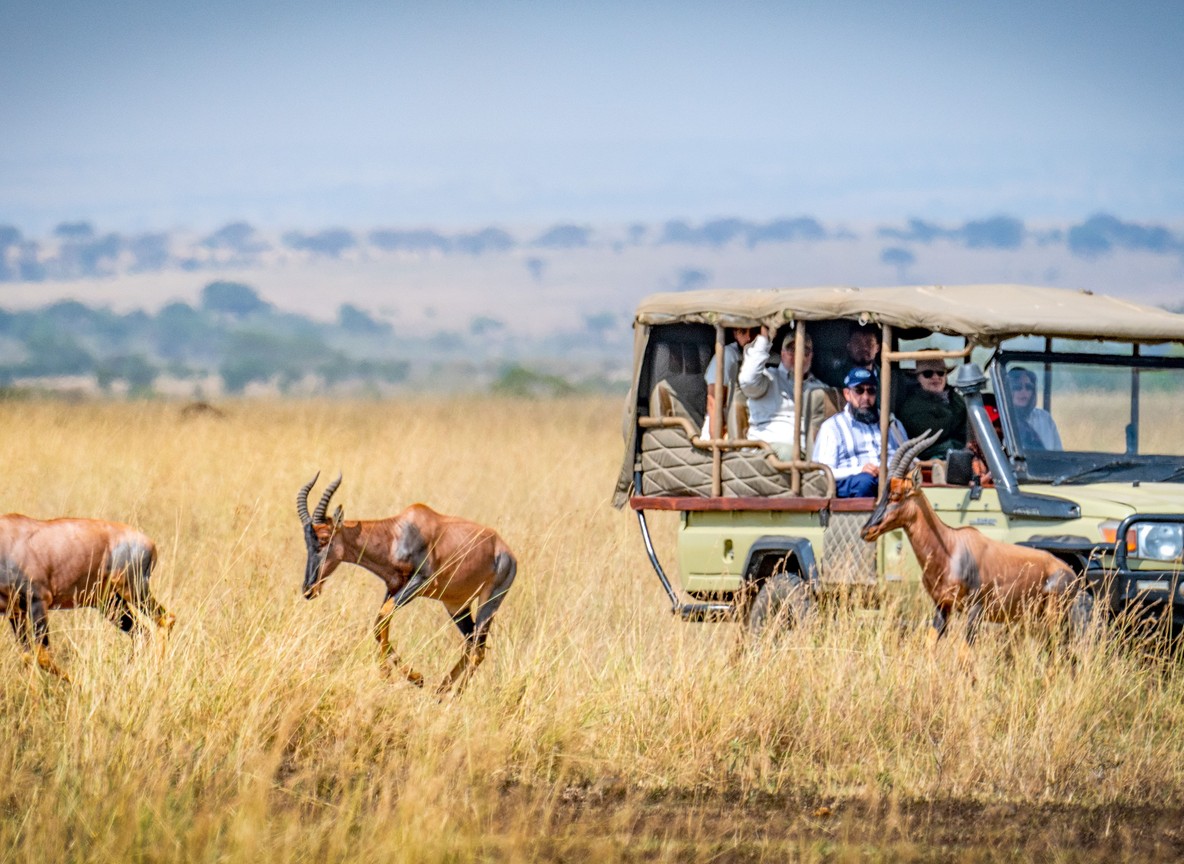
Conservancies enforce strict bed-cap policies. The number of guests permitted per square kilometer is capped under each conservancy’s management agreement. A typical conservancy with three or four permitted camps may put only three to five vehicles on a major predator sighting. During peak season in the national reserve, the same type of event commonly draws 40 to 80 vehicles.
That difference in vehicle density changes the character of a game drive considerably.
Conservancies also permit three categories of activity that the national reserve does not:
Night game drives. After the national reserve gates close at 6pm, conservancy vehicles can continue driving into darkness using red-light spotlights. Nocturnal species become visible in a way that afternoon drives cannot match: genets, civets, aardwolves, and hunting cats in active pursuit through open habitat.
Walking safaris. An armed ranger leads small groups on foot through the conservancy. The experience reorients how the safari feels. Tracking becomes deliberate, scale becomes apparent, and the bush is encountered from ground level rather than through a vehicle window.
Off-road game drive access. Vehicles can leave established tracks to approach wildlife directly. This matters for photography positioning and for reaching terrain that reserve roads do not cover.
What the National Reserve Offers
The Masai Mara National Reserve holds the most recognizable Big Five habitat in Kenya. The Mara River, the stage for the annual wildebeest crossings, runs through it, and the lion territories here are among the most studied and most visited in East Africa.
The reserve is accessible from camps across a wide budget range, which makes it the practical starting point for many first-time visitors. The wildlife density is genuine. During crossing season, the scale of the spectacle is extraordinary. The trade-off is that solitude is not guaranteed, particularly in the most active areas during peak months.
Both conservancy and reserve guests can reach the Mara River crossings, though routes and entry points differ by camp location.
Community Conservancy vs National Reserve: Conservation Impact
The community conservancy model has earned consistent support from conservation economists and wildlife biologists working in East Africa. Its core mechanism, making wildlife economically valuable to the people living alongside it, has expanded the effective wildlife range of the greater Masai Mara ecosystem well beyond the national reserve boundary.
When Maasai families receive reliable monthly income from lease fees, three outcomes tend to follow. Poaching incentive drops. Habitat conversion to agriculture slows. Movement corridors between protected areas are more likely to be maintained. The national reserve model, by contrast, operates closer to a boundary-based protection approach, where wildlife is managed within a defined perimeter rather than through economic alignment with adjacent communities.
For travelers paying attention to where their safari spend goes, the conservancy model places money in the most direct relationship with the wildlife and communities it supports.
Quick Comparison
| Factor | Community Conservancy | National Reserve |
|---|---|---|
| Management | Community trust or landowner group | County government |
| Revenue distribution | Directly to Maasai landowners and community fund | County government budget |
| Bed cap | Strict per-km limits | None |
| Guest density | Very low | Higher, especially in peak season |
| Game drive access | Off-road permitted | On established tracks only |
| Night game drives | Permitted | Not permitted |
| Walking safaris | Permitted with armed ranger | Generally not permitted |
| Conservation model | Wildlife as community livelihood | Boundary-based protection |
| Best for | Exclusive access, conservation-focused travel | First-time visitors, wider budget range |
Explorer Notes
Combining both. Many itineraries include nights in a conservancy camp alongside game drive time inside the reserve. This approach covers the low-density exclusivity and activity range of the conservancy while keeping access to the reserve’s iconic crossings and wider wildlife coverage.
Crossing season timing. Wildebeest river crossings typically peak between July and October, but timing shifts year to year and is not predictable. Both conservancy and reserve guests can reach the Mara River. Vehicle density at a given crossing is usually higher from the reserve side.
Conservancy fees are additive. The conservancy fee is charged on top of the camp rate. If game drives cross the reserve boundary, a national reserve entry fee may also apply. Confirm the exact fee structure with your camp before arriving.
Walking safari practicalities. Walking safaris run in small groups, require a reasonable level of physical fitness, and are generally not suitable for young children. Most conservancies cap group size at six to eight guests. It is worth asking whether the camp you are considering offers walks daily or only on request.
Photography priorities. If minimal vehicle crowds and off-road positioning matter to you, a conservancy stay during peak season is the most reliable route to both. The national reserve during the high season is excellent for wildlife but crowded at popular sightings.
Which Setting Fits Your Trip
Choose a community conservancy if you want low vehicle density, night drives, walking safaris, or off-road game drive access. Choose it also if where your fees go matters to you and the direct community and conservation connection is a priority. The cost premium over a reserve stay is real, and most travelers who weight those factors find it justified.
Choose the national reserve if you are visiting Kenya for the first time, working within a tighter budget, or looking for the widest range of camp options. The wildlife experience is genuine, the landscapes are iconic, and the crossings are accessible.
The two settings are not competing options. A well-planned Kenya itinerary can include both, drawing on the particular strengths of each for different parts of the trip.
Every trip described here can be tailored: dates, budget, camps, and pace built around you.
Get a Personalised Safari